
Why Your Google Map Pin is the New Front Door—And Other Digital Shifts You Can’t Ignore
The Digital Fragmented Reality
Modern business owners often feel a sense of digital exhaustion. The pressure to maintain a constant presence on Facebook, keep a Google listing current, and manage a functional website can feel like running three separate businesses at once. It is easy to view these platforms as a series of disconnected chores rather than a unified strategy.
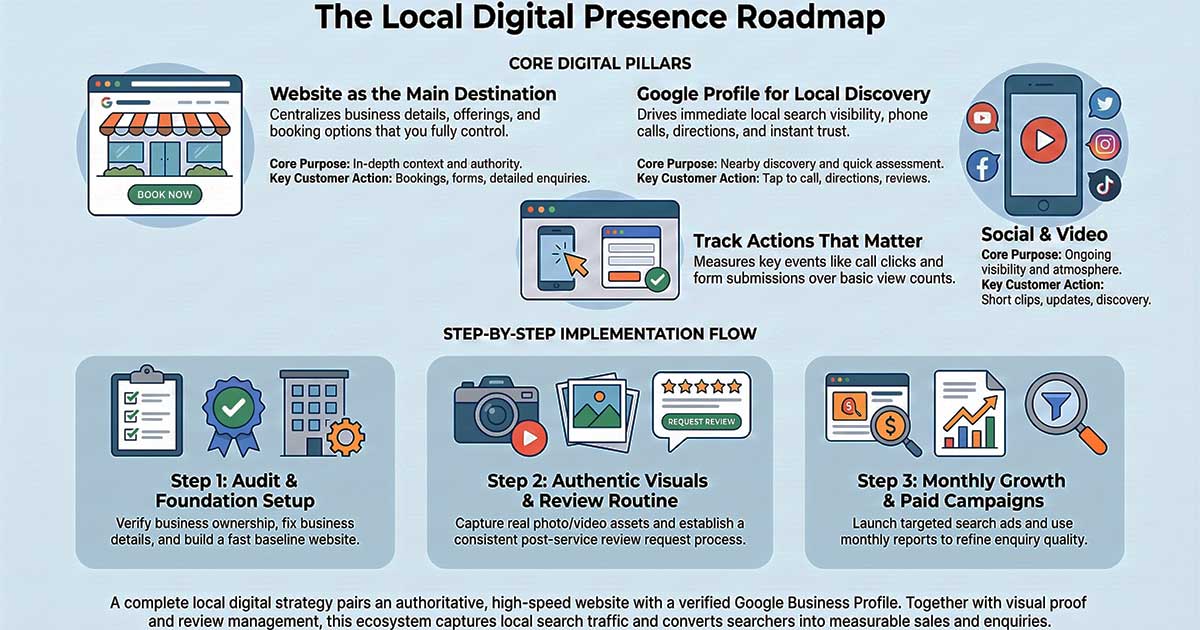
However, a successful digital presence is no longer just about “being online.” It is about building a cohesive ecosystem where every platform serves a specific role. To move from digital noise to a clear, professional identity, you must follow a sensible order of work: first fix the business facts, then your website and Google profile, establish measurement, and only then focus on content and paid campaigns. Understanding this progression is the key to creating a presence that actually converts.
1. Optimizing for the AI “Researcher”
The landscape of Search Engine Optimization (SEO) is shifting. We are moving away from a world where businesses only optimize for traditional keyword searches by humans. Today, we must also account for “AI discovery.” Tools like ChatGPT and Google’s AI features now act as researchers, vetting options on behalf of the user.
To remain visible, businesses must ensure their data is structured so these algorithms can easily ingest it. This means providing clear service descriptions, consistent contact information, and up-to-date location details. This represents a fundamental shift from human “searching” to algorithmic “vetting.” You are no longer just competing for a click; you are competing to be the most reliable answer provided by an AI assistant.
Google says its established SEO practices remain relevant to its AI search features; OpenAI also documents how site owners can make public pages accessible to ChatGPT search.
2. The Website is Your Only Sovereign Territory
It is a common question: why invest in a website when social media and Google Maps are free? The answer lies in control. Social media is for discovery; Google Maps is for being found locally. However, your website is your “sovereign territory.” It brings the entire picture together: what you offer, where you operate, and why a customer should choose you.
Relying solely on third-party platforms is a significant business risk. If an algorithm changes, your “front door” could be hidden overnight. Your website provides a stable home for information you control and serves as the essential destination for adverts, videos, and directory listings. It is the only place where you can truly own the narrative and accurately measure the transition from visitor to lead.
3. Accuracy Trumps Aesthetics in Visuals
When planning imagery, the most valuable assets are those that provide an accurate representation of the customer experience. While polished images are nice, authenticity is the real currency of trust. An accurate photograph answers the customer’s immediate question: “Is this the place I’m looking for?”
To build this trust, every business needs a specific “shot list” tailored to their industry:
- Accommodation: Honest views of each room type, bathrooms, parking, and the actual surroundings.
- Restaurants: Signature dishes, the storefront, and the genuine dining atmosphere.
- Service Businesses: Photos of staff, branded vehicles, and examples of completed work on-site.
Photos are often the fastest way to answer “Is this the place I’m looking for?” … An accurate photograph is more valuable than a polished image that creates the wrong expectation.
4. Reviews are a Public Conversation, Not a One-Way Street
Online reviews should be managed as a three-part service strategy: Ask, Monitor, and Learn. You must consistently ask genuine customers for honest feedback, but you must never offer discounts or gifts in exchange for reviews, as this is strictly prohibited.
When responding to feedback, keep it short and human. If you receive a complaint, acknowledge the concern publicly to show you are responsive, but move the private details and resolution into a direct conversation. Viewing reviews as a conversation rather than a marketing hurdle allows you to gain operational insight. If multiple reviews mention a specific issue, it is a signal to update your operations or your website information.
5. Stop Tracking Clicks, Start Measuring “Key Events”
Many businesses waste marketing budgets by focusing on “vanity metrics” like total visits. A click does not guarantee a sale. To understand if your digital presence is working, you must use tools like GA4 and Search Console to track “key events”—meaningful actions such as direction requests, WhatsApp messages, or confirmed booking enquiries.
It is vital to remember that a “tap” on a phone number does not necessarily mean a completed call or sale. By focusing on these high-intent local metrics and search queries, you can judge lead quality rather than just traffic volume. This is especially important for paid campaigns; instead of broad spending, begin with one specific offer and one measurable goal. This ensures your spend is generating a return rather than just inflating numbers.
6. Conclusion: The Future of Your Digital Front Door
The digital world has shifted from simply “having a profile” to “maintaining a presence.” There is a critical distinction between the two: setup gets the facts and ownership right, but ongoing care keeps the listing trustworthy. Whether it is a Google Map pin or a website page, every touchpoint must be accurate, accessible, and credible to both humans and AI.
As we move into an era where AI assistants research your business before a human ever sees it, the clarity of your information is your greatest asset.
Closing Question: If an AI assistant searched for your business today, would it find a clear, reliable answer, or a digital maze?