
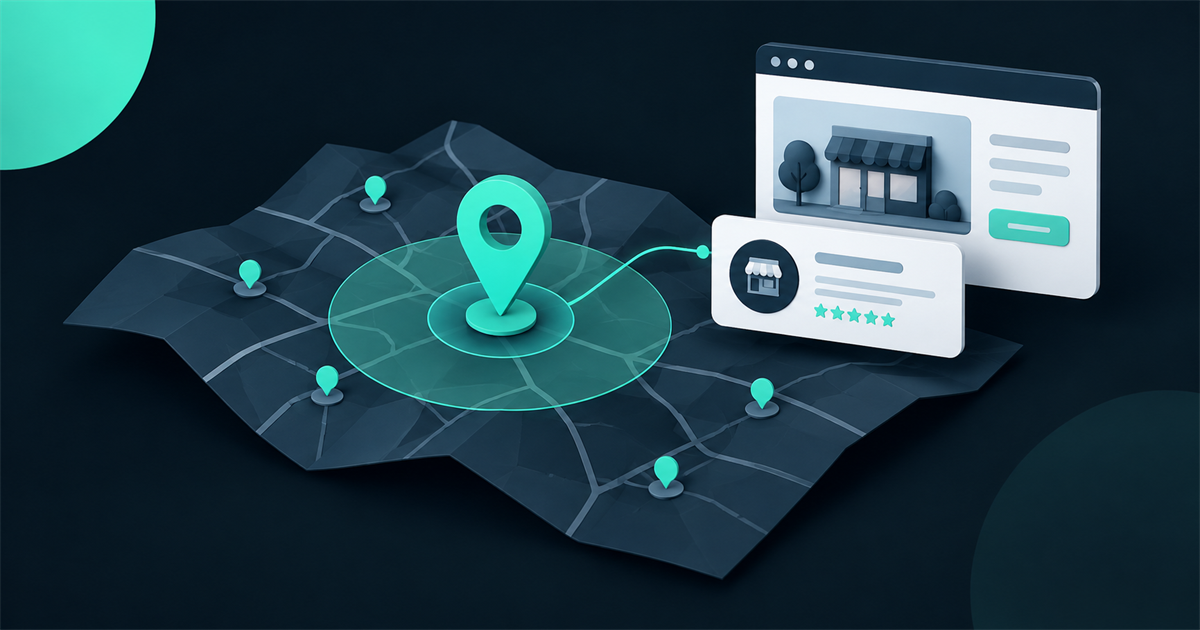
Google Business Profile helps a local or service-area business appear where people search on Google and Google Maps. It is most effective when the profile is accurate, active and supported by a trustworthy website. It should not be treated as a once-off listing or as a replacement for the website.
For a service-area business, it is possible to hide a residential address and show the areas served instead. This is important for businesses that travel to customers and do not receive visitors at their operating address.
What is a service-area business?
A service-area business visits or delivers to customers rather than serving them at a public storefront. Examples include photographers, consultants, trades, mobile services and many professional businesses working across a region.
The address used for verification must be legitimate, but it does not have to be displayed publicly when customers are not served there. The profile should then define realistic service areas. These areas help customers understand availability, but they do not guarantee rankings in every place listed.
Start with accurate business information
The foundation is simple and often neglected:
- Use the real-world business name consistently.
- Select the most accurate primary category.
- Add relevant secondary categories without stretching the truth.
- Use a phone number and website controlled by the business.
- Set accurate hours and keep special hours current.
- Describe the services in clear customer language.
- Hide the address if customers are not received there.
Consistency matters because customers may encounter the business through Maps, Search, the website, social profiles and directory listings. Conflicting details reduce trust and create unnecessary friction.
Choose service areas carefully
A service area should reflect where the business genuinely operates and can provide a reliable service. Listing a large number of distant towns does not create genuine local relevance. It is better to communicate a credible operating area and support it with real work, useful content and customer evidence.
When a business is preparing to relocate, avoid creating a trail of premature or contradictory location signals. Keep the website wording truthful and relatively broad until the move is complete. After settling in the new region, update the profile, website and important citations as a coordinated change.
For Fugle, the sensible approach is to retain the current South African positioning while the move from Mpumalanga is in progress. Garden Route location language—such as Great Brak River or Groot Brakrivier, George and Mossel Bay—should be introduced when it reflects the actual operating base and service plan.
Your website provides the depth
A Google Business Profile gives customers a quick view, but the website should provide the complete explanation. Each important service needs a clear page that answers:
- Who is the service for?
- What problem does it solve?
- What is included?
- What does the process look like?
- Where is it available?
- What proof or experience supports the claim?
- What should the customer do next?
The profile can then link to the most relevant page instead of sending every visitor to a generic homepage. This also gives Google and AI-powered browsing systems clearer context about the relationship between the business, its services and its geographic market.
Photographs are business evidence
Original photographs help potential customers understand the business before making contact. They can show people, completed work, equipment, products, properties, locations and the process behind the service.
I have worked with photography since 1999, including people, landscapes, property and product photography, largely using Nikon equipment. That experience has reinforced a practical point: photographs should do more than decorate a profile. They should answer questions and provide credible visual proof.
Useful profile images might include:
- A clear logo and brand image.
- The person or team behind the business.
- Recent completed work.
- Before-and-after comparisons where appropriate.
- Products photographed consistently.
- Behind-the-scenes process images.
- Recognisable regional context without exposing private details.
Use sharp, honest images and avoid relying entirely on generic stock photography.
Reviews need a responsible process
Reviews are strongest when they are requested from genuine customers at a natural point in the relationship. Do not offer rewards for positive reviews or try to control the wording.
Respond to reviews professionally. A useful response acknowledges the customer and, where suitable, refers naturally to the service provided. Responses should never reveal private project details or become overloaded with keywords.
Negative feedback also deserves a calm response. Address the concern, move sensitive discussion to a private channel and show future readers that the business takes service seriously.
Use updates to distribute useful information
Google Business Profile updates can share recent work, practical advice, service changes and seasonal information. They are most efficient when adapted from stronger source content on the website.
For example, one detailed article can become:
- A short profile update with a link to the article.
- A photograph and practical tip.
- A social-media post.
- A short video answering the central question.
- A future frequently asked question on a service page.
This approach keeps the website as the durable source while using the profile and social channels for distribution.
Measure more than profile views
Profile performance should be evaluated alongside Search Console, website analytics and actual enquiries. Useful measures include website clicks, calls, direction requests where relevant, search visibility, enquiry quality and the pages people visit after leaving the profile.
Add tracking parameters to important profile links so analytics can distinguish this traffic. Review patterns monthly rather than reacting to every small movement.
A practical monthly local-visibility routine
- Confirm the business information, hours and service areas.
- Check for profile edits or notices that need attention.
- Add recent, useful photographs.
- Request reviews from eligible customers and respond to new reviews.
- Publish an update based on a website article, project or service priority.
- Review profile performance, Search Console and enquiries together.
- Choose one improvement for the website or profile.
Common mistakes to avoid
- Displaying a home address when customers are not received there.
- Stuffing locations or services into the business name.
- Selecting misleading categories.
- Creating duplicate profiles for the same business.
- Listing unrealistic service areas.
- Leaving old hours, phone numbers or website links unchanged.
- Publishing frequent low-value updates with no connection to the website.
- Buying reviews or using reviews that are not genuine.
Related field notes
- What should happen after your new website launches?
- How one useful idea becomes a month of digital content
The role of ongoing management
The work is not merely “posting on Google.” It is the coordinated upkeep of the business information, website, customer evidence, content and measurement that support local discovery.
Fugle’s visibility service is intended to combine website care, Google Business Profile upkeep, Search Console monitoring, on-page improvements and a concise monthly next-action report.
See Fugle’s local-visibility and digital-presence services, or start a conversation about preparing a service-area business for Google Search and Maps.